Why Collaborative Play Is Essential for Early Language Development
Children learn language through active engagement rather than passive absorption. They learn through interaction, repetition, disagreement, and fun with other kids. The best environments for these social interactions are not classrooms or using flashcards. They are playgrounds, creative play areas, and with two children disagreeing over what the roof of a block tower should look like.
Contents
What Structured Group Settings Actually Provide
A child who spends most of their early years in a home environment typically has one or two main language models. That’s not a failure, it’s just a limitation of the setting. A structured group environment introduces something different: peer modeling at scale.
Children pick up vocabulary, sentence structures, and social language rules from other children, often faster than they do from adults. There’s something about hearing a same-aged peer use a word correctly that makes it stick. It’s imitable in a way that adult speech sometimes isn’t.
The serve-and-return dynamic is central here. According to the Harvard University Center on the Developing Child, these back-and-forth interactions are so essential that chronically absent or unreliable responses during early childhood can lead to measurable disparities in learning and behavior. Children need volume, many exchanges, throughout the day, with different conversational partners.
This is one reason why choosing a quality Childcare Auckland setting matters beyond simple supervision. A well-run center provides the frequency and variety of those interactions that a home environment, through no fault of its own, often can’t match at the same scale.
Why Play Demands Language
When a child is playing alone, they don’t have to explain anything. They just pick up the toy, do something with it, and put it down. Easy.
Add a second kid. Now you need to communicate the rules, allocate the parts, and know what the partner is trying to achieve, while having a completely different model of what a perfect game would be. Suddenly gestures don’t cut it. If I want to be the “captain”, I must say so. Coherently.
That’s where expressive language comes in. Not in sterile exercises, but real life situations where the child needs to get their point through, the game will stall otherwise. That’s why it’s so important to actually treat such conflicts as serious instances of training children responsive language of the same complexity as adults: trying to convince or explain with the help of descriptive words but under the urgency of the game continuing.
The Shift From Parallel to Associative Play
Toddlers usually play near each other rather than with each other. This parallel play is important for developing social skills, but the phase can last for years if kids aren’t helped to move on. Associative and symbolic play are the next and most important steps, and these depend on language.
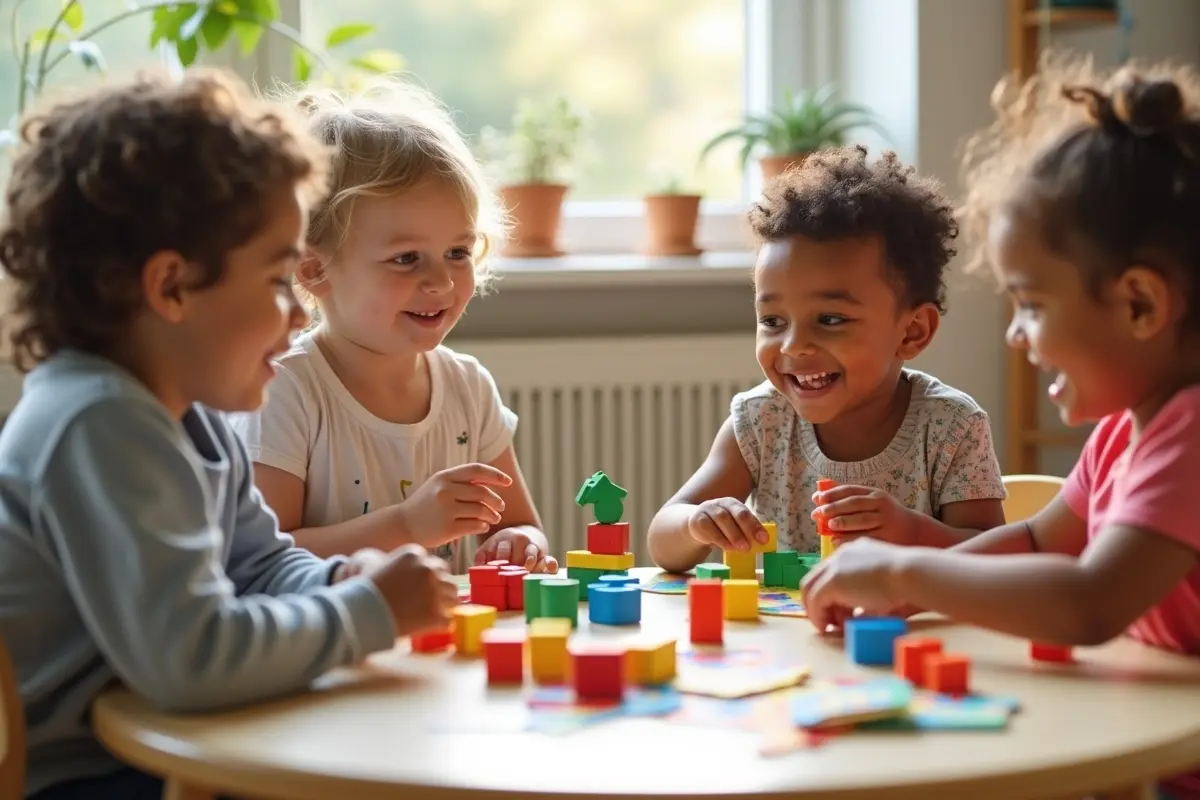
Associative play has children attending to what their playmates are doing and joining in or responding. They might build separate things with blocks, but they’re talking about each other’s work and gradually merging it into a single game. Or they might toss a ball, taking turns to catch it, never speaking but still mentally syncing their movements. Their worlds are becoming grounded in this new third space made of shared play and mental collaboration.
Symbolic play occurs when a child uses an object to represent something else or pretends. They might use a stick as a horse or an image in a game to stand for them in the game’s world. This level of play really is language, abetted by props. The imaginary scenario can be spoken or merely understood, but at least one child is always communicating covertly if they’re coordinating with siblings or friends.
The Relaxed Brain Learns Faster
Affecting the language learning environment has a lot to do with attitudes: your enthusiasm for the game will be contagious. But it also has to do with respecting the child as a language professional. It’s not your job to get the language out of them, any more than you need to make a seed grow. Your work is to create the optimal conditions and time for learning to happen.
Persistence matters a lot in learning, but I’m not sure it’s the right concept when we talk about children and language. To them, the hundreds and thousands of words they’re learning are not a task. It’s how they interact with the world. You didn’t ‘persist’ in learning to talk. You did it whenever there was something you wanted to say. That’s what we’re signing children up for when we support their language learning.
Getting the Environment Right Matters
Language does not mature according to some internal clock that games can simply tick faster. Games directly form it. And play where children negotiate rules, resolve disputes, and make their imaginary world come to life especially so. The children who talk more in those games, practice the most with the elements of language that will prove most challenging at school. And they arrive at school ready to excel socially and academically.